Hello! My name is Tom Voisine, and I am currently a Master’s engineering student specializing in Autonomous Robotics in France, at the École Nationale des Techniques Avancées (ENSTA), in Brest.
As part of my studies, I have the opportunity to undertake a four-month internship (May–September 2026) at the NORCE Research institute in Grimstad, Norway, where I am working on a project led by the CARM Centre.
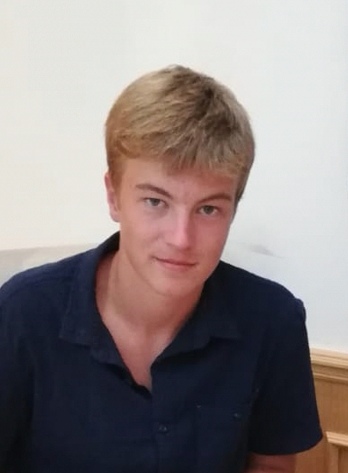
About me
I have a particular interest in robotics and in the development of intelligent and autonomous systems. Such work actually covers a wide range of fields: electronics, programming, control theory, and the integration of sensor-based systems.
What encouraged me to come and study and work at NORCE is its ambition to connect research in these fields to real-world challenges. The work carried out by CARM, which addresses the challenges of recovering critical raw materials, therefore really resonates with me.
I also enjoy experiencing new cultural and social environments, which is another reason why I wanted to study outside my home country!
Some context about my work at CARM
I am working on the development of an autonomous system for recovering recyclable and valuable components from old laptops that are no longer usable. The amount of electronic waste produced worldwide has been increasing significantly in recent years. This waste is often processed and sorted with limited selectivity, and frequently manually, before being shredded.
This makes it difficult to extract valuable materials such as copper or lithium afterwards. With environmental concerns in mind, as well as Europe’s desire to reduce its dependence on the extraction of some of these materials, research is therefore focusing on the development of systems capable of carrying out more selective and faster sorting of electronic waste and components before they are shredded.
Further details
The system I am working on relies on a robotic arm capable of locating the screws on the back of a laptop, drilling them out using an electric spindle equipped with a drill bit, and then removing the cover using a vacuum gripper in order to access the various electronic components inside. The entire process must be fully autonomous, from start to finish, without any human intervention.
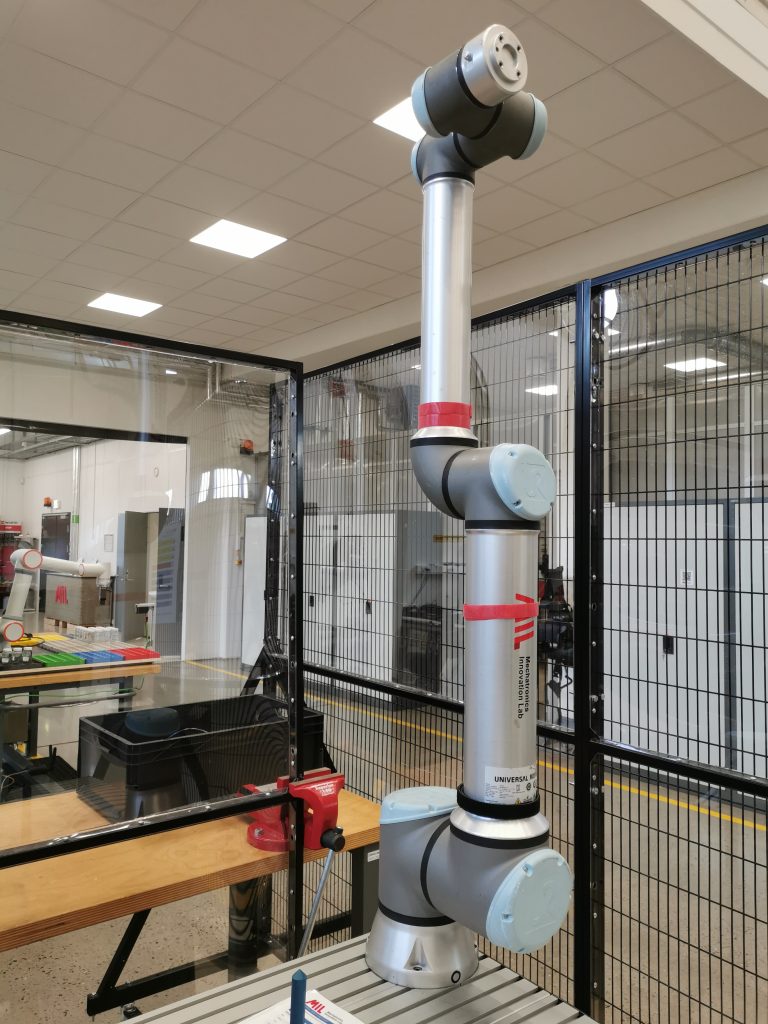
Arm used : UR10e
Drilling the screws rather than unscrewing them provides a slight time saving and is suitable for a wide variety of screw types. The main challenge is to develop a fast extraction method while preserving the integrity of the different components.
The screw detection relies on camera vision and is the work of another CARM student.
Challenging work
This project has been challenging in many ways. I had to get to grips with the entire hardware setup, from the robotic arm itself to the different tools. I also had to build a complete software architecture to control these elements and execute the entire sequence. This involved a long period of simulation and modelling, as well as carrying out numerous isolated tests before building the complete sequence.
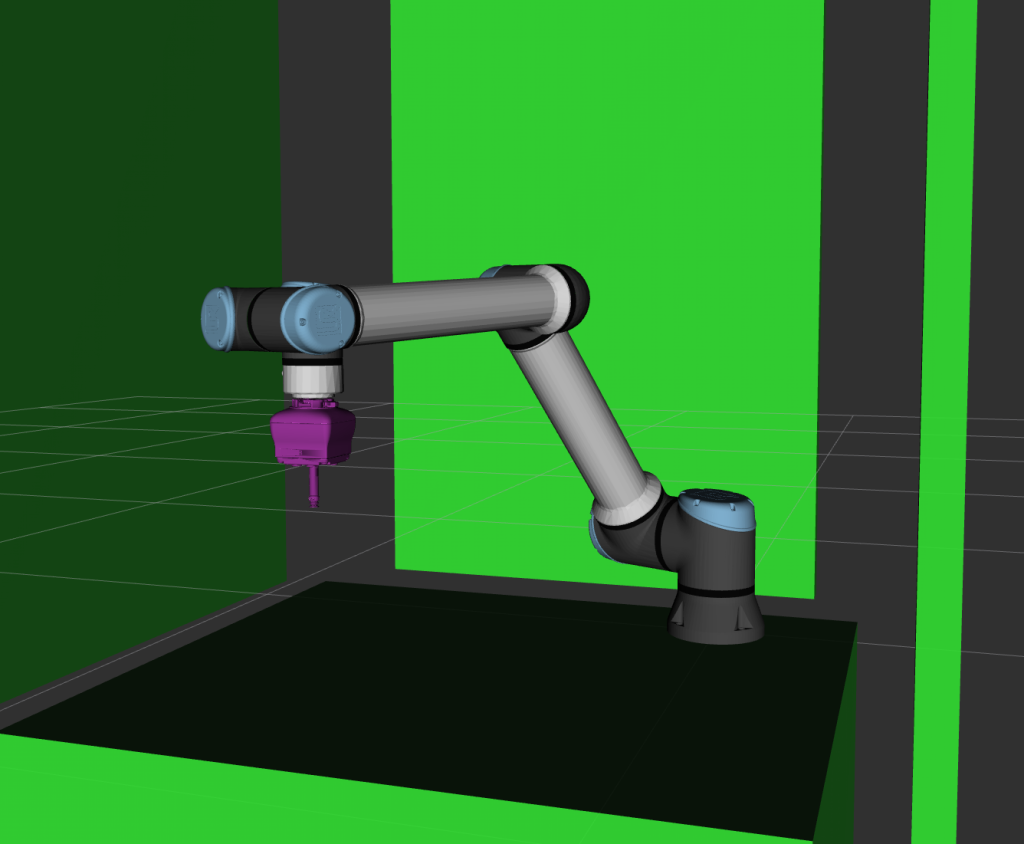
Simulation of the arm with Rviz
The robot must be able to change tools autonomously, and developing the system also requires many decisions regarding the choice of certain parameters in order to save as much time as possible throughout the sequence.
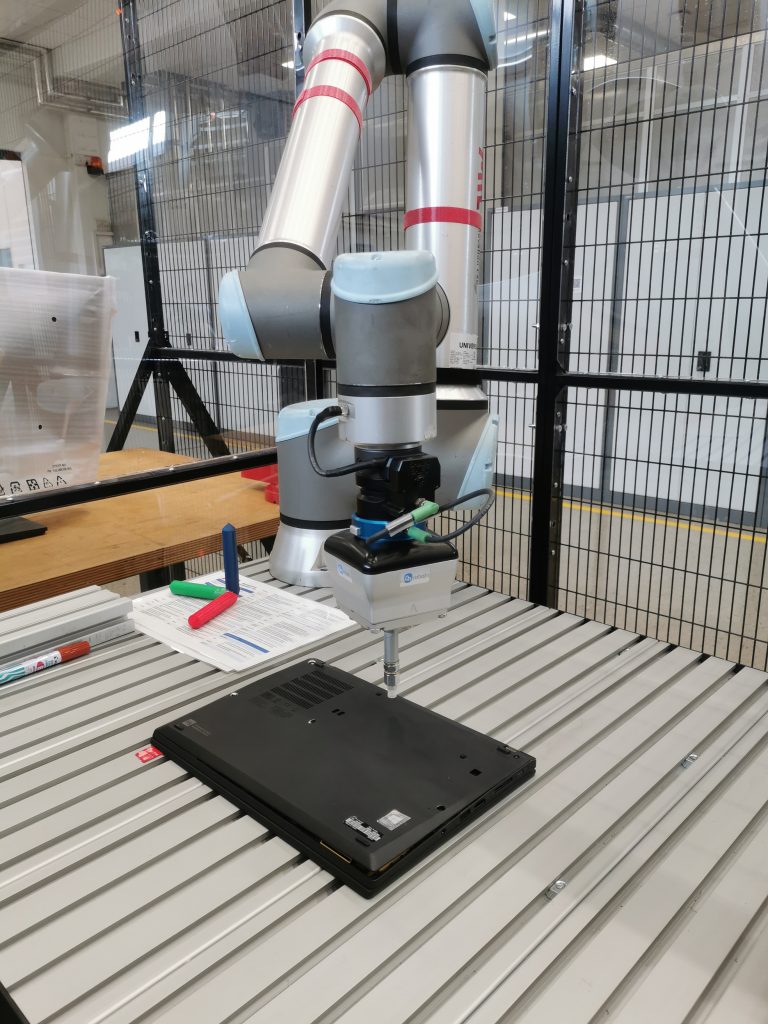
UR10e arm with vacuum gripper
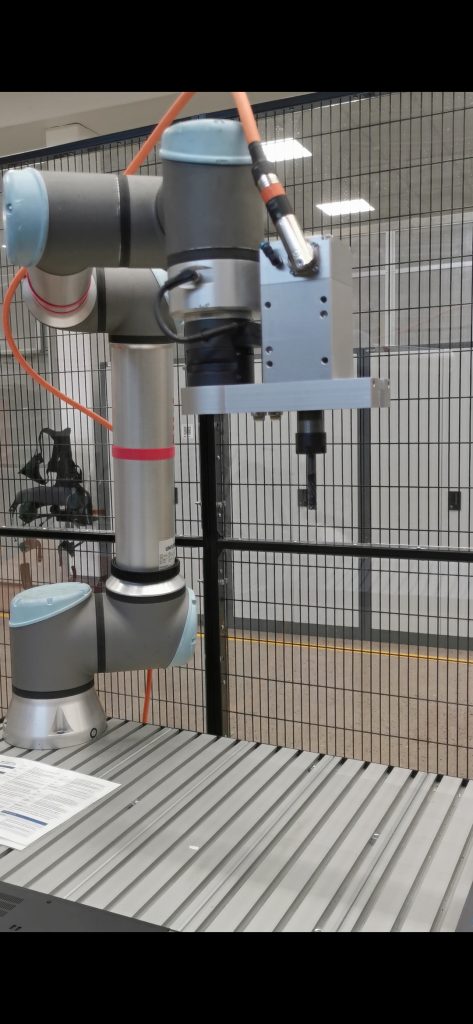
UR10e arm with spindle
The sequence could still be made more efficient, and this is precisely why it is important for research such as this to continue, so that solutions like these can eventually be industrialised in the coming years.
A Rewarding Experience
I have learned a great deal during this internship. This experience has allowed me to confront real robotic systems in a very concrete way, as well as the practical challenges that come with them. In particular, I realized how important it is to proceed step by step and build each stage on a solid foundation before moving on to the next one.
I have gained valuable experience with ROS (Robot Operating System), which is an essential middleware in this field. I also really enjoyed being part of a research-oriented environment and having the opportunity to exchange ideas with different researchers.
Thanks for your attention!